
AC

AC

AC & DC

AC & DC

AC

DC

DC

DC
Now that you are familiarised with the different types of connectors, you will have noticed that they all make reference to AC or DC.
I'll spare the explanation in the different types of power transmission methods, and assume that you already understand the difference, but what does it mean for electric vehicles and charging up?
Batteries deliver energy in the form of Direct Current (DC). They charge with DC, they discharge with DC. Charging up a battery with AC requires the original energy source to be converted to DC using a rectifier in order to feed into the battery charging circuit. That power conversion is carried out in one of two places.
Since DC Chargers are costly and take up a considerable amount of space and weight, it is logical to keep these components out of the vehicle and kept in a dedicated external device. Electric Vehicles do however need to convert AC from AC chargers/wall-outlets to DC within the onboard charger, yet for every kW of power the onboard converter is required to convert to DC, the cost of the converter increases, so does the weight, size and the amount of cooling required during the charge session.
So in a nutshell, AC chargers are lower in power output compared to DC chargers for the simple reason that it's too expensive and unfeasible to convert high AC power to DC inside the vehicle.
Let's take a closer look.
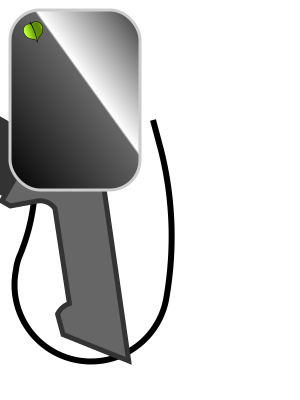

AC chargers can come in many form factors which are suited to their place of installation. Some appear to be bollards/posts, others are discrete boxes.
Here is a typical charging wallbox you may see in a public place such as a shopping mall carpark, or installed in a home garage/parking bay.
This example shows that the charger cable is provided at the charger and there is no need to use your own cable. Other chargers may simply be equipped with a socket, as per the adjacent image.
The Type 1 connector is the AC connector for the US and Japanese markets. Designated by its standard, the J1772 connector allows a single-phase AC supply (connected to the building mains) to connect straight into the car where the AC is then converted to DC inside the vehicles onboard charger. Electric Vehicles in these markets are often supplied with a charge cable allowing the driver to bring the cable along with them and connect to the nearest charger (or mains socket). Due to its limitations of single-phase supply, the Type 1 AC charger is really only suitable to charge vehicles at up to 16A, which is close to 3kW. However, as a home charger, this is still deemed sufficient.
While it is prevalent in USA and Japan, the Type 1 connector can still be found in other markets where US or Japanese Automakers are exporting their vehicles, however, many automakers now equip their export models with charger sockets compatible with the destination country's adopted standards. In many cases, this is the Type 2 AC connection.
The Type 2 connector (originally known as the 'Mennekes') is the main AC connector for European automakers. It can carry either single or three phase AC supply, so it is not uncommon to find AC chargers in the public realm capable of 11/22kW power output. The same connector can be used on home chargers with single-phase 10A/16A supplies. The earlier models of the Renault Zoe (Q90-version) were able to charge at 43kW using this type 2 connector (charger-dependent), but it remains the only EV to have had this capability, since, as mentioned earlier, the car needs to convert 43kW of AC to DC and this requires a higher-rated power converter and also additional cooling during the charging session. This option has since been dropped by newer models of the Zoe. Many Automakers are fixed upon 11kW charging as standard, with 22kW sometimes as an option.
The GB/T AC connector looks remarkably similar to the Type 2 AC connector, yet the different pin arrangements make them incompatible.
The GB/T AC has 3 phase connections, Power Earth, Neutral and two pilot connections for proximity and control.
GB/T AC chargers are equipped with female sockets, so do the China-market Electric Vehicles, and the connection is made via a male-to-male charging cable.
It is unlikely, but not impossible to find GB/T charging equipment internationally. Many countries adopt IEC/UL standards but the GB/T charger is not compliant to those. Furthermore, in a market where charging standards are not restricted to a single solution, it would make the life of a charging infrastructure developer a misery by needing another connection type to provide for, therefore, GB/T is the charging solution developed by China, for China.
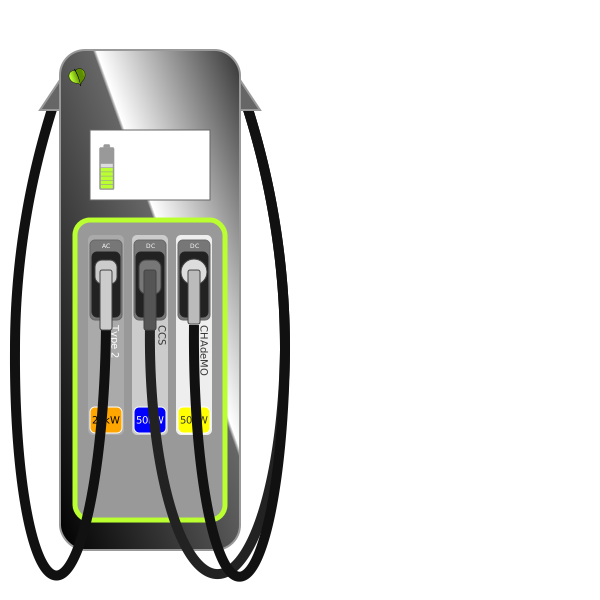
DC Chargers also come in a number of different packages. From smaller lower-powered wallboxes for homes/offices, to floor-standing units such as that depicted below, to even higher powered units that require additional cabinets to house the power modules (especially for electric bus/heavy-vehicle chargers where >300kW is required). For highways, it is not uncommon to find multi-standard chargers that are capable of connecting to vehicles with up to three different connections, depending on the format provided by the automaker.
The Combined Charging System (Type 1) is in a nutshell, a Type 1 AC connector that includes two additional pins for the DC charging. Therefore, a vehicle can be equipped with a CSS Type 1 socket and be charged either using a Type 1 AC charger, or with the CCS Type 1 charger. The Type 1 connector carries all of the same interconnects and signalling between the charger and the vehicles onboard battery management system.
The Combined Charging System (Type 2) is the same concept as the CCS Type 1 connector, only it uses the Type 2 pin arrangement instead.
CHAdeMO, the tradename of a charging standard developed by a number of Japanese automakers, which literally means 'fancy a cup of tea?', was introduced back in 2010 to facilitate DC charging, at the time, up to 50kW. The charging standard has been introduced into many countries around the world where EV's are present (at least imported from Japan), and remains a significant share of the DC charge plugs, however, some countries, notably Singapore singled out CCS Type 2 as the only DC charge type for public charging, so there is certainly a battle between the standards and their adoption around the World. It is still too early at this time to say whether there will be an outright winner that shall prevail.
As with the GB/T AC charger connector, the DC version was developed in China for China and is not making much impact on the global markets, however, private commercial operations may establish their own GB/T charging infrastructure to accompany a China-origin electric vehicle fleet.
The Tesla DC port used for their Supercharger network is predominantly for the US-market. As Tesla roll out their vehicles around the World, the cars are being fitted with Type 2 + CCS Type 2 sockets
As if mastering the connectivity wasn't taxing enough, EV chargers are also categorised by their power supply capacity.
You may have heard about Level 1, Level 2 or Level 3 chargers.
Below is a table outlining the different power ratings and supply requirements for Level 1 and Level 2. In short, Level 1 chargers are typically synonymous with home chargers. Level 2 chargers are those you would expect to find in the public space, although they can still be installed in homes since the power requirements are possible for properties with sufficient supply, and Level 3 is considered DC Fast Charging. The power requirements for Level 3 chargers are often beyond the capacity available in a residential property, so they are typically installed in Commercial applications such as Petrol Stations and dedicated highway charging stations. Their energy demand can be anywhere from 3-phase 100A up to 300A and more.
| Level 1 | Level 2 | ||||||
|---|---|---|---|---|---|---|---|
| Type 1 | 1.4kW | 2.4kW | 3.7kW | 7.4kW | 11kW | 22kW | 43kW |
| Single Phase 120V | 12A | 20A | |||||
| Single Phase 240V | 16A | 32A | 45A | 90A | |||
| Type 2 | 3.7kW | 7.4kW | 11kW | 22kW | 43kW | ||
| Single Phase 240V | 16A | 32A | |||||
| Three Phase 415V | 16A | 32A | 63A | ||||
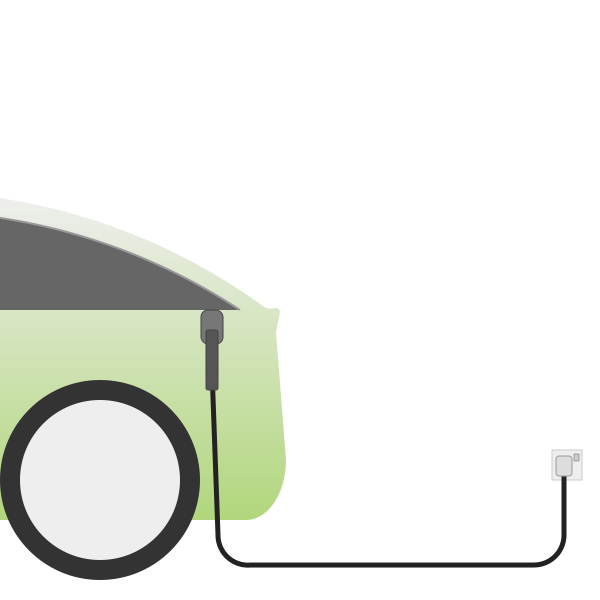
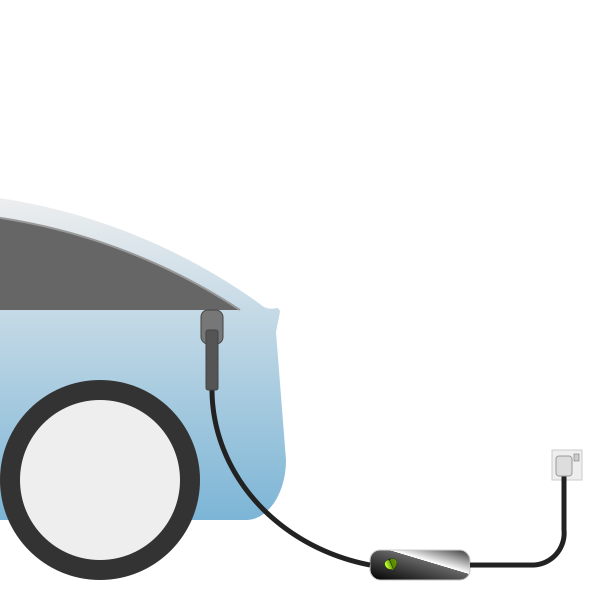
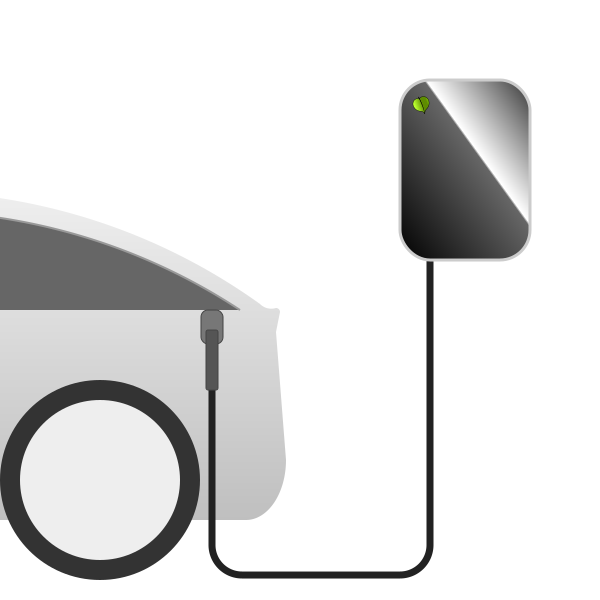
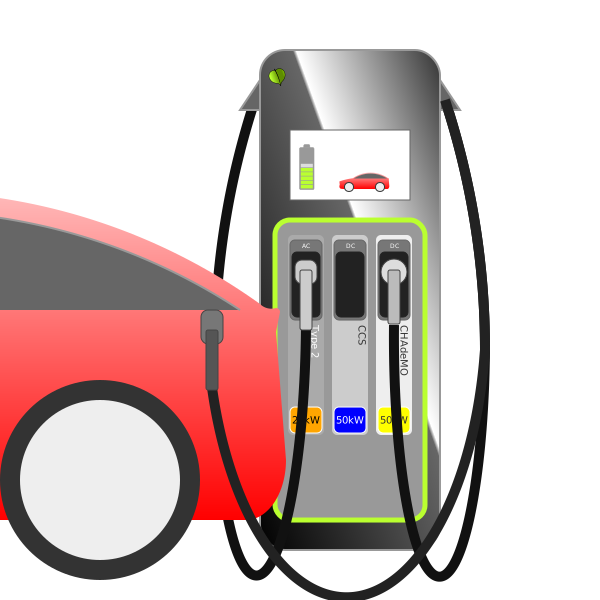
MODES describe the type of the connection being made between an Electric Vehicle and the source of energy. These MODES describe what kind of hardware stands between the cars battery management system and the grid power supply. The images below are hopefully self-explanatory. You will see that Modes 1 and 2 are suited for home charging. Modes 3 and 4 are for public charging infrastructure.